Stationary Energy Theory, a new biocentric theory of cosmology that workably ties together the physical and spiritual realms, unifies electromagnetic and nuclear forces with gravitation, and much more.
A thinking-outside-the-box cosmology that fits the facts & math
Author: Mark J. Mason
Author: Mark J. Mason
If you have any questions or comments:

Is "Heaven" Made of Microwaves?
Stationary Energy Theory is a theory of physics and cosmology that is deeply rooted in mathematics. For instance, its equation for gravity, Fg = ˝mc˛(α – σ)/d, can be used to calculate the acceleration of the rate of expansion of the universe, and the value it comes up with is within the error limits of the value measured by astronomers. The fact that this equation for gravity contains the term “mc˛” also enables a connection to be made between gravitational force and nuclear and electromagnetic forces. When lined up with the right structure for the universe it can also explain why gravitational force is so much weaker but so much more ubiquitous than electromagnetic or nuclear forces, and can provide a common equation for all three. This article goes on to explain this, once the necessary groundwork has been laid. Before diving into this, though, I want to briefly mention another aspect of this theory—its ability to show how the physical and spiritual realms can be tied together into one unified whole.
Mystics of many spiritual traditions agree there is a spiritual realm and also largely agree about its nature. This theory sees such a realm as the intelligence behind the organized complexity of the universe, and provides a mechanism by which it could operate. As such it is a biocentric theory of cosmology, but it is one that proposes a workable model, including the math, as well as showing how consciousness can create the physical universe. It sees the spiritual realm, cosmic consciousness, Brahman, the astral plane or heaven—whatever you wish to call it—as being an information-rich matrix of electromagnetic energy, within the four dimensions of space-time, that serves as a blueprint for how the organized complexity of the physical universe unfolds. As the universe expands, it scans this energy blueprint, or “morphic field” of consciousness, which this theory, along with some spiritual masters, says is made of electromagnetic radiation (EMR). As it so happens, there exists a field of suitable electromagnetic radiation, in the form of microwaves, permiating the whole universe in a way that fits in perfectly with this theory. It is known as Cosmic Microwave Background (CMB) radiation. So, according to this theory, heaven is made of these microwaves! This corresponds, to some extent, with David Bohm's 'Implicate Order.' This theory I am presenting, however, does not propose an aether permiating space that EMR propagates through, but just has EMR itself permiating everywhere and everything.
There is more about the spiritual realm being made of microwaves, and the implications this has for human use of microwaves, toward the end of this article, here.
Introducing the Theory (with some easy math you can skip over if you wish)
Now, for those of you who are still with me!, let's dive into the physics! Stationary Energy Theory, in addition to being a biocentric theory, as discussed above, arises from looking at the universe in a different, four-dimensional, way rather than in just a three-dimensional frame of reference with time merely tacked on. We will go into this a little later, but first I want to briefly introduce this cosmology to you and present a new theory of gravity this cosmology gives rise to. This theory has its own equation for gravitational force that explains how the universe is expanding faster and faster all the time (accelerating). It also explains the rather different way stars orbit around spiral galaxies (their flat rotational speeds). Previously, science has explained these things by proposing the existence of vast amounts of “dark energy” and “dark matter,” but this theory says dark energy and dark matter are not needed, and predicts they will never be found. Indeed, scientists have been looking for dark energy and dark matter for a long time without finding any of either.
It is a Unified Field Theory
This theory achieves the long-sought-after goal in physics of unifying gravitation with nuclear and electromagnetic forces. I know this is a big claim, but I confidently make it, and will show you how the unification works later in this article, once the groundwork has been laid for it. This theory, in addition, reveals how it is that time flows, explains why EMR (and matter) have both a wave nature and a particle nature, proposes a different way for black holes to form other than by stellar collapse, explains the speed and quantity of the fast solar wind, and provides a mechanism for the evolution of the organized complexity of the universe, such as life. The math has been largely worked out for the theory, and it corresponds well with what astronomers have observed. It adheres to the cosmological principle that the universe, on a large scale, looks the same in every direction (is isotropic) and that matter and energy in it are fairly evenly distributed (homogeneous), but differs significantly from the currently popular standard model of the Big Bang, while agreeing that there was a Big Bang. The most interesting part of this theory's math is its equation for gravity, that can be used to calculate a value for the acceleration of the expansion of the universe that is in close agreement with the observed value, and that plays a significant part in the unification of gravitation with nuclear and electromagnetic forces, mentioned above.
This web page is an introductory article about this new cosmology theory. At the end of the article there are 21 links to a series of articles that fill in the details of this model and provide the derivations for its mathematical equations. To go straight to these links, click here. For more information on scientific concepts in the following article, please mouseover and/or click their links.
Problems with Dark Matter and Dark Energy
The existence of “dark matter” has been inferred from the inability of Newtonian gravity and General Relativity to explain the
flat rotational speed of starsFlat Rotational Speed of Stars
Mercury moves in its orbit faster than other planets because it is closer to the sun and the sun's gravity pulls harder on it. One would expect stars closer to the center of the galaxy to likewise move faster than stars further out. This does not happen, though, in spiral galaxies such as our own. Rather, the stars further out move at the same speed as, or sometimes even faster than, stars closer to the center. Thus it is said that stars in such galaxies have a "flat rotational speed."
For more information, please click the link.
around spiral galaxies without it. Likewise, the existence of
“dark energyDark Energy
A mysterious form of energy that has been proposed to account for the accelerating expansion of the universe, but which has never actually been detected.
To read a Wikipedia article about dark energy, please click the link”
was inferred from the inability of these gravitational theories to explain the
accelerating expansion of the universeAccelerating Expansion of Universe
Astronomical observations have shown that not only is the universe expanding at a very high speed, but the speed at which it is expanding is also gradually increasing, or accelerating.
For more information, please click the link.
To return press the browser back button.
without it. Only by assuming the existence of extraordinary amounts of dark matter and dark energy, amounts that exceed that of ordinary matter by over 20 times, can these traditional gravitational theories be rescued. Yet despite determined efforts to find particles of
non-baryonic, non-neutrino dark matterNon-baryonic, Non-neutrino Matter
Baryonic matter is the normal matter things are made from. There is a small amount of baryonic dark matter (dust clouds etc.), and some neutrinos, in galaxies, but not nearly enough to account for the rotational speed problems. You can't shine a light on "non-baryonic dark matter." It can only at all easily be "observed" gravitationally.
For more information, please click the link.
(which nearly all of it must be), as of this writing not a single particle has been detected. Dark energy has never been detected either. But worse still, most quantum field theories predict a
cosmological constantThe Cosmological Constant
Einstein introduced a "cosmological constant" into General Relativity to make the theory seem to support a static, rather than an expanding universe. He later repudiated it, calling it "The greatest mistake of my life." It has since been reintroduced as a measure of dark energy to try and explain the observed acceleration of the rate of expansion of the universe. It may well end up being repudiated for a second time!,
a measure of dark energy, that is more than 100
orders of magnitudeOne order of magnitude larger is ten times larger. Two orders of magnitude is 100 times larger. 100 orders of magnitude larger is larger by a factor of a "1" with 100 zeros after it — a truly astronomical number!
larger than needed to account for the observed rate of acceleration of the expansion of the universe. This ranks as by far the most inaccurate prediction in the whole history of Physics.
This situation has, very understandably, led some researchers to propose theories of gravity that would explain the dynamics of the universe outside our solar system without the need to resort to the far-fetched explanation that our universe is dwarfed by dark matter and dark energy that we can’t even detect. Unfortunately, these theories have not, to date, been able to fully explain what is going on in the universe.
A New Way of Looking at the Universe
I hope to do the same with this new theory of mine, and I believe it is plausible enough to be taken seriously. It is, no doubt, not yet fully complete as a theory, and I look forward to it being improved through the input of others. It was not, however, worked up just as an alternative to dark energy and dark matter. It arose as a logical consequence of its new way of seeing the structure of the universe, something I hope to convince you of as quickly as possible, since it would be very easy to just ‘reverse engineer’ a gravity formula to explain the known rate of acceleration of the expansion of the universe. This theory’s basic equation for gravitational force is:
Fg = ˝mc˛(α – σ)/d . . . . . . . (32)
where 'm' is the smaller mass in kilograms (the larger mass, 'M,' being a factor in α), 'd' is the distance between the masses in meters, α is a “deflection” angle and σ is a “splay” angle (both in radians). α is exactly equal to the angle by which light is bent on the way in to its closest point to the larger mass. Since light is also bent by an equal amount on its way out from the larger mass, α is exactly half of what the ‘gravitational lensing’ is for that object. So, at the surface of the sun, where the gravitational lensing has famously been measured to be 1.7511” of arc,
α = 0.87555” of arc = (0.87555/(60 x 60))pi/180 = 4.24479 x 10⁻⁶
radians.
σ, the ‘splay,’ is no arbitrary value, either. It is the angle between each mass and the midpoint between them due to the curvature of the universe. More precisely, it is the distance to this midpoint divided by the radius of curvature of the universe. This radius of curvature may be very great within complexes of superclusters of galaxies, where the geometry of space is very ‘flat’, but between these supercluster complexes the radius of curvature is, overall, the same as the radius of the whole universe, 46 billion light years. This means that on this large scale:
σ = 0.5 x dly/4.6 x 1010 = dly x 1.09 x 10⁻¹¹ radians
The value of σ is thus rooted in two very real values, the distance between the objects, and the radius of the universe, so it is certainly not arbitrary or ‘reverse engineered.’ α is a measure of how much space is ‘curved’ in a ‘concave’ way by the larger mass. σ is a measure of the ‘curvature’ of space in the opposite ‘convex’ way due to the universe being a 4-D sphere. In this respect, and according to this model, the universe is very much like a golf ball, which has lots of concave dimples but is overall convex, since it is a ball, after all. Within the curved in ‘dimples’ of the universe gravity is attractive, but between dimples, where space is curved outward overall, gravity becomes repulsive.
It is noteworthy that this equation for gravity, Fg = ˝mc˛(α – σ)/d, doesn't need the gravitational constant, G, in it. This is because this theory says the force of gravity is deflected speed-of-light kinetic energy operating at a distance. As a result, terms for speed-of-light kinetic energy, deflection and distance are in the equation, but no gravitational constant is required, yet, as we will see, this equation gives the same results as Newton's equation when σ = 0. We will see why this is later in this article. It is also noteworthy that this equation shows that gravity is not a fundamental force as it can be derived from speed of light kinetic energy deflected through the angle of bending of space.
It is significant that this equation for gravity contains the term 'mc˛', because, as we shall see, this, along with other features of this theory, enables the long-sought-after unification of electromagnetic and nuclear forces with gravity.
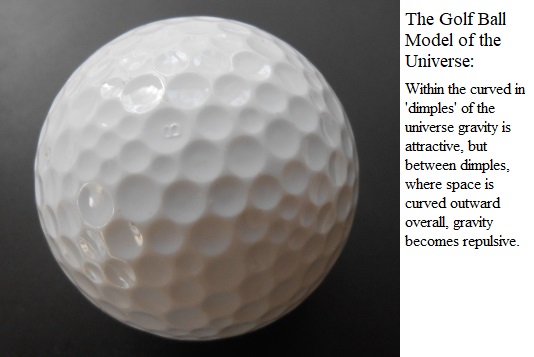
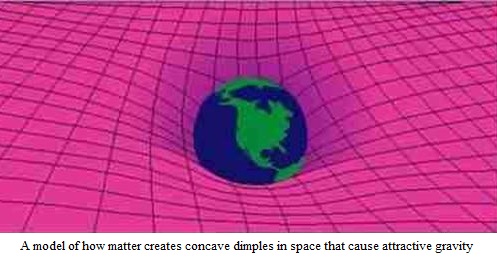
When calculating forces between large objects like the sun and planets in the close confines of the solar system, σ is tiny compared to α, and can be ignored, but when looking at the huge distances between superclusters of galaxies, and especially between complexes of these superclusters, σ becomes greater than α and the force of gravity becomes negative, and this drives the acceleration of the expansion of the universe.
Testing this new equation for gravity within the solar system
Let’s look first at the case where σ is insignificant. In this case, this theory’s equation becomes: Fg = ˝mc˛α/d, and it should, when evaluated for a particular situation, give the same result as Newton’s equation. So, let’s compare the results we get in a real situation by using this equation and Newton’s to find the gravitational force in Newtons of a 1kg mass (m = 1) at the surface of the sun.
On the surface of the sun light is bent by 1.7511” arc, so α is half that, or 0.87555” arc. Converting to radians, this is: (0.87555/(60*60))pi/180 = 4.24479 x 10⁻⁶ radians. Using this theory’s equation, Fg = ˝mc˛α/d , this figure for α, and m = 1 we get:
F = 0.5 x 1 x 299,792,458 x 299,792,458 x 4.24479 x 10-6 /695,700,000 = 274.19 Newtons.
Using Newton’s equation, Fg = GMm/d˛, and m = 1, we get:
F = 6.67390 x 10-11 x 1.98855 x 1030 x 1/(695,700,000 x 695,700,000) = 274.20 Newtons.
As you can see, the two results are as close to being equal as could be expected, considering the limited precision of the different inputs used by each equation. Only four significant figures are justified, and at this precision both results are equal at 274.2 Newtons.
I have just shown that when σ is tiny, this theory’s basic equation for gravity is in close agreement (in correspondence) with Newton’s equation, and that σ itself, when it comes into play, is not an arbitrary figure, but one based on real, relevant, observed values. In other words this equation has not just been ‘reverse engineered’ to give the desired results, it is a real and useful equation describing reality.
To use this theory’s basic equation for gravity, in most cases we need to be able to calculate α and σ to slot into the equation. I have derived equations for these, in terms of SI units, and they are, along with the basic equation again, as follows:
Fg = ˝mc˛(α – σ)/d . . . . . . . (32)
where:
α = M x 1.48514333 x 10⁻²⁷/d
. . . . . . (30)
σ = d x 1.14888 x 10⁻²⁷/f . . . . . . (33)
'f' is a flatness factor, which can be quite high within superclusters of galaxies, where space can be very 'flat,' but, as already discussed, equals 1 on the very large scale of the universe.
Another way to find α is to equate this theory's basic equation for gravity, with σ = 0, to Newton's equation for gravity and solve for α:
˝mc˛α/d = GMm/d˛
Canceling m from both sides, dividing both sides by c˛, and multiplying both sides by d and 2, we get:
α = 2GM/c˛d
which you may recognize as being exactly half of the well-known equation for gravitational lensing:
θ =4GM/c˛d
We did, of course, start off by saying that the deflection angle, α, is exactly half the amount light is deflected by gravitational lensing, so this is another confirmation that our math is correct, and that this theory's equation for gravity is a real equation for gravity.
This theory's basic equation for gravity can, as might be expected from the above math, be derived from Newton's equation for gravity and the gravitational lensing formula, and this is the second way I do it in Article 15. Since it is such a simple derivation, I am going to present it here in this Introductory Article, as well:
A Derivation of Stationary Energy Theory's Basic Equation for Gravity
Stationary Energy Theory builds on some parts of General Relativity but goes beyond it in proposing that the "concave" curvature of space which objects with mass cause, and α is a measure of, is reduced over great distances by the "convex" curvature of space arising from the universe being, overall, a four-dimensional sphere. This "convex" curvature is called the "splay," σ, in this theory, and σ is equal to half the distance between the two objects divided by the average radius of curvature of the universe in the space between them. So Stationary Energy Theory proposes that the force of gravity is in proportion to α - σ, and can, at great distances, where σ exceeds α, become a negative force, or repulsion, instead of an attractive force. To derive an equation for gravitational force based on this does not require the mechanism proposed by this theory for how matter bends space, but depends only on the fact that space is bent. We will start by including (α - σ), the net angle of bending, as one term of the equation, and specifying 'R' as the rest of the terms, such that:
Fg = R(α - σ)
At close distances, such as within our solar system, where σ limits to zero:
Fg = Rα
Where σ = 0, this equation should give the same result as Newton's equation, so:
Rα = GMm/d˛
So:
R = GMm/d˛α
We have defined α as half of the gravitational lensing around an object. Since the equation for gravitational lensing is θ = 4GM/c˛d, then
α = 2GM/c˛d
Putting this value for α into the above equation for R, we get:
R = (GMm/d˛) × (c˛d/2GM)
Cancelling out the 'G's, the 'M's and one of the 'd's, we get:
R = mc˛/2d
Substituting this back into our original equation, Fg = R(α - σ), we get:
Fg = mc˛(α - σ)/2d
Or, multiplying top and bottom by ˝, we get this theory's Basic Equation for Gravity:
Fg = ˝mc˛(α – σ)/d . . . . . . . (32)
This Theory's Basic Equation for Gravity Accurately Predicts the Rate of the Acceleration of the Expansion of the Universe
We have now shown, in two different ways, that this theory's basic equation for gravity gives the same values as Newton's equation when σ = 0, but what about at great distances where this equation says σ significantly reduces the force of gravity, and can even make it negative so it is a repulsive force? The ultimate test of this would be to apply the formula on the grand scale of the universe to complexes of superclusters of galaxies to calculate how much acceleration of the rate of expansion of the universe it would produce, and compare the result to what astronomers have measured. I in fact do this in Article 16, using both this theory's basic equation for gravity and another one-step form of the equation.
The result I get (initially a negative one indicating a repulsion, not a deceleration) is:
7.34 x 10⁻¹⁰ m/s/s.
The observed rate of the acceleration of the universe is usually quoted as 73.8 ± 2.4 km/s/Mpc (Mpc = million parsecs), which which when converted to SI units gives: 73.8 km/s/3.26 x 106 years = (73.8 ± 2.4 x 1,000)/(3.26 x 1,000,000 x 365.25 x 24 x 3,600) m/s/s =
7.17 ± 0.23 x 10⁻¹⁰ m/s/s.
As you can see, the calculated result from this theory’s equation for gravity is within the margin of error of the observed value! This shows that this theory's equation for gravity is accurate when σ is high as well as when it is effectively zero, making it accurate across the full scale of the universe. Showing how gravity can account for the acceleration of the expansion of the universe, of course, makes 'dark energy' unnecessary, so it is a prediction of this theory that large amounts of dark energy, as distinct from the mechanisms this theory proposes to account for negative gravity, will never be found.
Compared with Newton's equation for gravity
So, does this theory predict any differences from Newton's theory in how gravity works in our solar system? Yes, but only extremely slight differences. I am assuming a flatness value, 'f,' of around 2,500 in the spiral arms of our galaxy where we live, which seems to fit in with various observed values in physics and astronomy (some of them mentioned in the supplementary articles—but note, an accurate value for 'f' in the spiral arms of our galaxy will have to be calculated from detailed observations of the proper motions of stars in the area). With this estimated value for 'f,' this theory's equation for gravity shows our sun should attract objects less than or equal to its own mass up to a distance of about 8.5 light years, and slightly repel such objects if they are further away than this. Within our solar system, though, the equation so closely approximates Newton’s equation that it would be difficult or impossible to measure the difference in most situations. At 0.085 light years from the sun, 182 times the distance of the orbit of Neptune, and far beyond the orbits of most comets, the force of the sun’s gravity would only be reduced to 0.9999G (that is, 0.9999 of what Newton's equation gives). At the orbit of Neptune, it would be 0.9999999968G.
The Structure and Function of the Universe in Stationary Energy Theory
We will now go on to look at how this theory models the structure and function of the universe, and how its mechanism for explaining gravitational force arises from the model.
This model of the universe, or cosmology, has been developed from basic first principles, by looking at the constancy of the speed of light in a different way than physics has to date done. The model leads naturally to a theory that explains how gravity works in terms of the interaction of fundamental particles within a universal energy field.
I will attempt, in the short remaining space of this article, to explain the basis of the theory. It is based on a model of the structure of the universe that is significantly different than previous models, and that has the power to simply explain why the universe is the way it is in many important ways. There will not be space in this article, however, to show how most of the equations of the theory are derived, to present many of the extensive ramifications of the theory, or even to fully present my reasoning. If you are interested in these, I refer you to a series of articles at the end of this article that further elaborates on the theory.
A different way of looking at the constancy of the speed of light
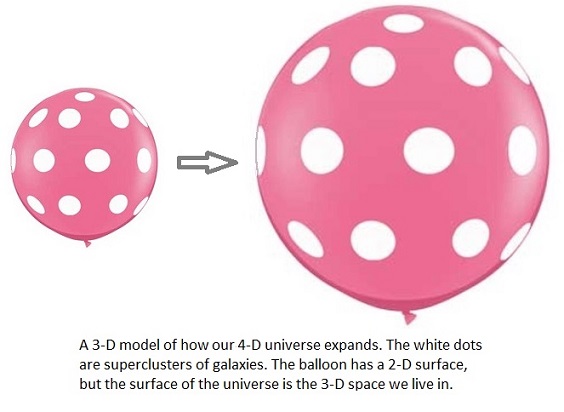
The famous Michelson-Morley Experiment, done in 1887, showed that the speed of light is always observed to be the same, regardless of the speed of the observer. Observations of binary stars likewise show the speed of light is always observed to be the same, regardless of the speed of the source of the light. This led to the abandonment of the notion that light is transmitted through a medium referred to as the 'ether.' The question then arose: with respect to which frame of reference (if not the ether) does light and other EMR move at its observed velocity of 'c'? Einstein answered that light moves at velocity 'c' with respect to all frames of reference, and that all frames of reference are equally valid. This was his extension of the principle of Newtonian 'relativity' to include electromagnetic radiation. This referred to three-dimensional frames of reference within space, and I would agree that this is true for all frames of reference in 3-D space. In the diagram below which uses a balloon as a model of the universe, none of the polka dots on the 2-D surface of the balloon can have a special claim to be in any way more central or important than any other. When we look at the balloon in three dimensions, however, we can see there is a center to the balloon that is within it and equally distant from all points on the surface of the balloon. The same is true when we look at our four-dimensional universe from a four-dimensional perspective. No place in the 3-D "surface" of our universe is in any way special, but there is a "center" of our 4-D universe that could be the basis for a four-dimensional frame of reference, and that "center" is the "event" of the Big Bang. With this in mind, there is another way of looking at the constancy of the speed of light that considers the possibility that the speed of light may be a relative speed, within the 4-D Big Bang frame of reference, and this is what this new theory, presented here, does.
This theory's way of stating the observed
constancy of the speed of lightConstancy of the Speed of Light
Light, and all electromagnetic radiation (EMR), is observed to have a constant speed in a vacuum, regardless of the motion of the observer. The famous "Michelson and Morley Experiment" showed this to be true. The speed of light appears to be slower when it passes through transparent objects, like the atmosphere or glass. In this theory, though, it is proposed that light does not actually slow down, but is absorbed by atoms in the transparent medium and re-emitted a tiny fraction of a second later. Light thus only seems to be moving slower in such media because it spends some of its time as matter between being absorbed and re-emitted by atoms.
in a vacuum and the equivalence of mass and energy is to say that electromagnetic energy and matter are two different
“quantum” statesQuantum States
Physical states of an object or substance, as in quantum theory, that are distinctly different with regard to the quantity of some measurable quality, and where intermediate states are not possible.
For an introduction to quantum theory please click the link.
of the same thing, where one is always moving at the speed of light relative to the other. To simplify looking at this, the theory specifies a frame of reference where one of these is “always at rest” and the other is always moving at the speed of light, and considers these two “quantum” states.
Other things being equal, it would be equally valid to consider either matter or energy to be “always at rest.” And physics has traditionally seen matter as being at rest (or almost), and electromagnetic radiation as traveling at the speed of light with respect to all matter, regardless of the speed of the matter. The problem with this, however, is that matter is clearly not always at rest, as it is often moving with respect to other matter. In particular, we know the universe is expanding, like a balloon being blown up, and all matter is moving away at a very fast speed from the event in space-time where the Big Bang occurred.
This would make the analysis very difficult if we were to choose to consider matter to be at rest, as I believe it has done for physics to date. So, when looking at matter and energy in this new way, it greatly simplifies and clarifies the analysis to consider that it is energy that is always "at rest," both in space and in time. One can then propose that all matter is moving away from the Big Bang point (or "event") at exactly the speed of light through
four-dimensional space-timeFour-dimensional space-time
The three dimensions of space plus the time dimension. In this theory the universe is expanding in the time dimension, like a balloon being blown up, forming a 4-D "sphere," the surface of which is our 3-D universe.
as the universe expands, and all energy is stationary in space-time relative to the Big Bang event, which becomes the anchor point for a new frame of reference in space-time for considering the dynamics of the universe. This is what this theory does, and it fully satisfies the constancy of the speed of light requirement: that the speed difference between electromagnetic energy and matter is always equal to the speed of light.
From this perspective, electromagnetic radiation (EMR) just seems to us to be moving at the speed of light because we are moving through a “stationary” EMR field at that speed due to the expansion of the universe. It would seem at first sight that this would mean that EMR should only appear to be moving in the time dimension, and not through space, as we are moving past the stationary energy in time. This would seem to be at odds with our observation that EMR appears to move through space. The short answer to this is that every direction in space is backward in time, so movement through time will be seen as movement through space in any direction. A more detailed answer is given in Article 11: The Nature of Electromagnetic Radiation in a 4D Universe.
This switch in reference frames to seeing all EMR as being a part of a “stationary” energy field, universal in nature, through which all matter is moving at the speed of light, is the critical insight of this theory and the foundation upon which its model of the universe is built. Everything else in this theory falls into place fairly simply once this assumption is made, with only simple math needed to derive equations that accurately describe reality and that resolve many significant dilemmas in modern physics.
What Moves and What Doesn't
The question of what is moving and what is “stationary” has always been important in cosmology. Ptolemy’s cosmology, which had the Earth being stationary and the sun and planets moving around it, made the motions of planets seem very complicated, requiring intricate combinations of
epicycles, deferents and equantsEpicycles, Deferents and Equants
In Ptolemaic cosmology the planets followed complicated paths through the sky formed by points on the circumferences of small circles, epicycles, rolling around inside larger circles called deferents. This whole system did not rotate around the center of the Earth, but rather around the mid point between the Earth and a point called the equant. All this was required to reasonably accurately describe the motion of the planets with everything rotating around the Earth. By contrast, with the planets rotating around the sun, simple eliptical orbits very accurately describe their motion.
to explain them. When Copernicus, Galileo and Kepler reversed this and had the sun being stationary and the Earth and planets moving around it, the motions of the planets became simple ellipses, and it opened up vast new vistas to science. What was initially considered fringe science became a paradigm shift that moved science into huge new areas of accomplishment. Seeing electro-magnetic energy as “stationary” and matter as moving at the speed of light, in a like manner, makes the universe much easier to understand, enables it to be described with much simpler math, and opens up solutions to long-standing dilemmas in modern physics and astronomy.
Moving at the Speed of Light through Time
This way of looking at matter and energy implies that when beings made of matter, like ourselves, are apparently at rest, we must actually be moving at the speed of light in some way that we can or can’t detect. There is, of course, a movement we can detect, even when we are apparently at rest, and that is our movement through time. If we assume that what we sense as a movement through time, or the flow of time, when we are “at rest,” is caused by us moving through the electromagnetic energy field of the universe at the speed of light, “c,” then the
Lorentz transformation for time intervals, the famous “time dilation” equation of Special RelativityTime Dilation Equation
Under this theory, all matter is considered to be moving at the speed of light compared with electromagnetic energy. Usually, most of this movement is through the time dimension, which we experience as the passing or flow of time. The total speed of matter through space and time, however, must be the speed of light, so when the speed through space increases, the speed through time must decrease. This causes time dilation — time traveling slower for very fast objects. See the first of the supplementary articles, Article 2 for a simple derivation of the equation.
Click on the link for a Wikipedia article about time dilation.,
is so simply derived that a good ninth grade math student could easily follow it. (Very simply, the idea is that as the speed of an object moving through space increases, its speed of travel through time must decrease, as their vector addition must add up to exactly the speed of light.) This confirms, in a rather spectacular way, the validity of the assumption that 'what we experience as the passing of time is us moving through the energy field of the universe at the speed of light,' and justifies including it as a part of this new theory. (To read this simple derivation, click here. There is also a link to this derivation—Article 2—at the end of this article.) The speeds mentioned here are all absolute speeds, measured with respect to the Big Bang reference frame, unlike the purely relative speeds of Relativity. As a result, time dilation works somewhat differently in this theory. For an explanation of how it works, and to read about a proposed verification experiment, please see Article 2 and Article 3.
What Eternity Is
According to this theory, matter did not start moving through time, experiencing the passing of time, until after the Big Bang, however the time dimension existed prior to that as one of the four dimensions of spacetime, scattered through which was a vast energy field. 'Eternity' might be a good word to describe what existed before the Big Bang, and that still exists along with the material universe that is expanding through it, creating the phenomenon, in matter, of time passing. This 'eternity,' (or 'eternal now') under this theory, is a consciousness of 'everywhereness' in space and time (omnipresence). There is no passing of time in the old-energy blueprint of the universe. The space dimensions, however, are really no different from the time dimension, so it must be true for the space dimensions, as well, so there can be no travel through space or time in the energy domain. Since all energy is stationary in space and time under this theory, this also precludes movement through space as well as time in this domain. This can be described as 'nonlocality' in space and time, as opposed to the 'locality' in space and time that characterizes the physical domain of matter.
Travel through time is perpendicular to any direction in space
It is important to note that, under this theory, in order for our universe to be
isotropicIsotropic
Invariant with respect to direction. The universe being isotropic means that the laws of physics work the same way whichever direction you are looking or moving in space. It has been a long-held principle of physics that the universe is isotropic.,
it turns out that our direction of travel through time must be perpendicular to all three space dimensions, so it will have no component in any of the space dimensions to cause the speed of light or the speed of passing of time to depend on the direction in which we are moving through space. (For the thought experiment that explains why, see Article 2.) This movement through time must, for a given observer, pass through a single “point in space,” since, as we just mentioned, there can be no component of the movement in any of the three space dimensions. According to this theory, such “points in space” form a rest frame that is, in a very real way, absolutely at rest. (We shall see, later, that this rest frame corresponds to the Cosmic Microwave Background radiation rest frame.)
A Big-Bang Centered Structure for the Universe
In this way, a model of the structure of the universe begins to emerge from the foundation of our new, Big-Bang centered, four-dimensional, frame of reference. As we shall see, what emerges is a model of the universe that is basically a four-dimensional sphere. This “sphere” is expanding at the speed of light due to matter moving away from a starting event (the Big Bang) at the speed of light through the time dimension. The radii of the sphere are in the time dimension, and the “surface” is in the three space dimensions, with hundreds of thousands of “flat” areas on this 3-D “surface,” like the dimples on a golf ball (where the geometry of space is very close to “flat”), each one occupied by a complex of superclusters of galaxies. This theory provides a specific explanation, arising out of its equations, for why there are these flat areas, and when observed data about the universe is plugged into these equations, they predict sizes for the flat areas of between about 400 million and a billion or more light years across—big enough to contain complexes of superclusters of galaxies, but small enough that different supercluster complexes, which have voids between them, be in different flat areas. (See Article 4 and Article 13 for more on the structure of the universe, including the math. Also see Article 21 to see how this structure can accommodate multiple parallel universes — though this theory doesn't predict or require them.)
Because this model of the universe is built on the idea that all matter is moving through a "stationary" universal energy field of EMR, and this suggests a very different structure for the universe than has previously been believed, I have provisionally called this model and its equations the “Stationary Energy Theory.”
An Easy Derivation of E = mc˛, and the Quantum Nature of this Theory
According to the Stationary Energy Theory, all matter is moving at the speed of light with respect to the four-dimensional “Big Bang/Universal Energy Field” frame of reference, even if most of this movement is through the time dimension, and is experienced by us as the passing of time. Since kinetic energy (the energy an object has because of its speed) is given by the equation: E = ˝mv˛, where ‘v’ is the velocity, or speed, of the object and ‘m’ is its mass, it follows that the amount of kinetic energy held by a piece of matter of mass ‘m’, traveling at the speed of light ‘c’ as it is in this frame of reference, that would be released if it made the quantum transition to being electromagnetic radiation, which is stationary with respect to this frame of reference, would be:
E = ˝mc˛ . . . . . . . . (10)
But if a piece of matter, an atom or a subatomic particle, is traveling at the speed of light, how can it be suddenly slowed down to zero speed, so its kinetic energy can be released? Newton’s first law of motion says:
Every object will remain at rest or in uniform motion in a straight line unless compelled to change its state by the action of an external force.
This means that to stop a particle like this there must be an external force—it cannot just stop itself. But what could this external force be? The only obvious thing that could stop a fast moving particle in its tracks like that would be if it collided with a particle of the same mass going the opposite direction at the same speed, like two cars in a head-on collision. This would mean a particle of matter would have to collide with a particle of the same mass traveling in the opposite direction through time at the same speed, “c”.
In this situation, this head-on collision would release the kinetic energy in both particles, and reduce the speed of both particles to zero, the quantum state of electromagnetic energy, and so release the energy as electromagnetic radiation. (Note that since such “backward through time” particles would be traveling at twice the speed of light relative to us, and would be extremely tiny, we would not be aware of them except when they make these collisions with ordinary forward-through-time matter—backward through time particles are examples of what physics calls 'tachions.') Such a collision would release an equal amount of kinetic energy from both particles into the Universal Energy Field we see as electromagnetic radiation. The total energy released, in terms of the mass of the particle we are aware of, which has mass “m”, would thus be:
E = ˝mc˛ + ˝mc˛
And adding the two terms on the right, we get:
E = mc˛ . . . . . . . . (11)
Why EMR/matter has both a particle and a wave nature
These energy releasing collisions would have to be totally “inelastic” for all the kinetic energy to be absorbed in head-on collisions. This theory proposes that these particles repel each other, when they are in motion with respect to each other, with a force that is both electrical and magnetic in nature. As a result, the kinetic energy would be absorbed into an electromagnetic standing wave of changing electrical and magnetic fields as the particles rapidly decelerate to zero speed and become photons (particles of light). We see this standing wave moving relative to us at the speed of light because of our own motion at that speed. This explains why electromagnetic energy has, at the same time, both a wave nature and a particle nature.
And since the conversion of electromagnetic energy to matter is the inverse of converting matter to energy, happening when EMR waves accelerate particles up to the speed of light, it also explains why matter, like energy, has a dual wave-particle structure, with the wave manifesting to us as a standing wave. An example of this is an electron appearing as a standing wave in its orbital around an atom. When the mass of an electron goes up, due to it absorbing energy and converting it to matter, the energy of the standing wave increases so it occupies a higher orbital. The opposite effect of an electron manifesting as a less energetic standing wave occupying a lower orbital happens when matter is converted to energy and photons and waves of EMR are released.
SET is a quantum theory, and explains the Uncertainty Principle
This theory also explains one of the central observations that gave rise to Quantum Theory, that it is not possible to predict exactly when or where an electron will appear in a new orbital when a photon is produced or absorbed, but only a probability of the event. This is because a collision between a cluster of basic, forward-through-time particles (BPs) and backward-through-time particles (BTTPs) must take place before the orbital jump can happen, and we don't know exactly when the next appropriate cluster of BTTPs will arrive on an exact collision course. And if you don't know when an electron is going to appear in an orbital, you don't know where either, as the electron is moving. It's rather like not knowing exactly when the next bus to where you are going will arrive at your bus stop. You can only say they run about every 10 minutes, and that there is, for instance, an 80% probability that a bus will arrive within 10 minutes and a 95% probability that one will arrive within 20 minutes. And will it arrive right at the bus stop sign or back behind another bus so you have to make haste to catch it? You just don't know exactly where it will be, either.
Schrodinger's Cat and other Quantum Paradoxes Resolved
There is a prevalent idea in quantum theory that things in the physical world exist only as probability waves until some human being observes them, their consciousness collapsing the wave function and making the things appear solid. This is supposed to show that consciousness creates the physical universe—our consciousness. One of a number of problems with this is that it defies the Copernican Principle, that the Earth and human beings don't occupy a special position in the universe, by giving humans the very special role indeed of creating the universe by observing it with our consciousness. Stationary Energy Theory, on the contrary, has everything in the universe, from sentient beings like us to grains of sand, sharing this role. The 'Old Energy' reprogrammable blueprint for the organized complexity of the universe is made of an EMR field possessing consciousness (awareness), and is there behind every little thing, even a speck of dust or an atom, and 'observes' it into existence. Since all the matter in the universe is, under this theory, already 'observed' into existence, there is an objective reality to it.
As to the Schrodinger's cat experiment, there is no proof that the cat in the box is both alive and dead at the same time until someone opens the box and observes the cat. This theory predicts that if you put a video camera in the box it would show a living cat until such time as the bottle of poison broke (if it did break) and killed the cat. This is because being dead or alive are mutually exclusive states, like being pregnant or not pregnant. On the other hand, this theory has shown how matter and energy can have both wave and particle natures, and that they are not mutually exclusive. I believe this wave/particle nature of matter and energy, and consciousness being behind all matter, can together explain all the remaining quantum paradoxes. If you say, as many do, that a measuring device like a video camera can't collapse the wave equation, but that only an observation by a human can, then there is logically only one possible result to the cat experiment, making it untestable, and hence bad science and merely a silly idea. Note: to avoid cruelty to cats, I would propose that anyone wanting to test my prediction of what a video camera inside Schrodinger's box would reveal, leave out both the cat and the poison in the bottle. If the radioactive decay triggers the 50% chance that the hammer breaks the bottle, that is all that is required. A bottle can't be half broken any more than a cat can be half dead—both are mutually exclusive!
The Uncertainty Principle and Wave-Particle Duality
We can see that Stationary Energy Theory not only recognizes, but also explains why, both matter and energy have a dual wave-particle nature. This is Niels Bohr's Principle of Complementarity, which says that EMR consists of both waves and particles at the same time, and that the wave and particle natures complement each other. Since the Heisenberg Uncertainty Principle in Quantum Theory arises as a result of this wave-particle duality, it follows that this theory is fully compatible with, and fully accepting of, the Uncertainty Principle. It is usually said that the Uncertainty Principle is a result of both the wave-particle duality, because a wave is spread out over space and doesn't just occupy one point, and the unavoidable interaction between what is being observed and the instrument doing the observing. When you think about it, though, this second factor, the unavoidable interaction, also depends on wave-particle duality. When any type of EMR is used to measure the position of a particle, the accuracy of the position is limited to the wavelength of the EMR used (uncertainty in position depends on wave nature), but the accuracy in measuring the momentum of the particle is limited by the momentum of the photon of EMR used to measure it, as it can, through collision, change the momentum of the particle (uncertainty in momentum depends on particle nature).
In SET, EMR and matter are two quantum states of the same thing
Stationary Energy Theory, of course, also quantizes matter and energy as such, saying they are the same thing in two quantum states, one (energy) being in a state of rest in space and time compared to a Big-Bang centered frame of reference, the other (matter) always traveling at the speed of light compared to the same frame of reference, although this constant speed is a vector addition of an object's speed through space and its speed through time. As a result, Stationary Energy Theory is a quantum theory in itself, and can, I believe, fully incorporate historic Quantum Theory within it. This is not to say that I think God 'plays dice' with the universe. The macro universe we live in is full of 99.999999999% certainties, which is a far thing from the chance play of a game of dice.
Backward through time particles and antimatter
The proposal of the existence of “backward through time particles” in order to explain how matter can make the quantum transition to being electromagnetic energy (EMR), follows logically from this theory’s “Universal Energy Field” model, simply and correctly yields the famous and long-validated equation E = mc˛ and elegantly explains why electromagnetic energy has both a wave and a particle nature, but is none-the-less a dramatic change in how we see the universe, and one which I entertained fleetingly for many years before having the courage to whole-heartedly embrace it. Having embraced it, however, this model's theory of gravity, already shown to accurately describe reality, followed simply and easily from it, in terms of interactions between “backward through time particles” (BTTPs) and “basic particles” (BPs) of ordinary (forward through time) matter. How this happens, we'll get to soon.
Meanwhile, I should say that the concept of collisions between normal matter and backward through time matter yielding energy according to E = mc˛ is not entirely new. Stephen Hawking, in his article "The Quantum Mechanics of Black Holes" (Scientific American, January 1977), says that, in Quantum Theory, an antimatter particle can be seen as "being really a [normal] particle that is traveling backward in time." What Hawking is referring to is the "Feynman–Stueckelberg interpretation" of antimatter. And, of course, antimatter particles, like backward through time particles, turn into energy according to E = mc˛ when they come into contact with ordinary matter. Also, antimatter particles, like backward through time particles, are not normally seen in the universe and are only observed where there have been high-energy collisions such as in particle accelerators. Could it be that antimatter and backward through time particles are actually one and the same thing?
Basic Particles of Matter
In these energy-releasing collisions between basic particles of ordinary matter (BPs) and backward through time particles (BTTPs) , the mass of a single colliding particle would have to be small enough that the energy in the least energetic possible photon of electromagnetic radiation would correspond to its mass in the equation E = mc˛. Then the simultaneous collisions of multiple particles (possibly in clusters) would lead to the release of higher energy photons. To produce a single quantum of ultra low frequency radio waves, the least energetic EMR known, the mass of a “basic particle” (BP), would have to be about 10-53 kg—vastly smaller than any currently known subatomic particle, but about the same size as the proposed strings in String Theory. Since the mass of an electron is about 10-30 kg (9.1 x 10⁻³¹ kg), an electron would be made up of about 1023 “basic particles.” (For the math on this, see Article 5.)
These “basic particles” (BPs) would be the smallest subatomic particles out of which all other particles are made. Since they would be the basic building blocks of matter, this theory proposes that they have electromagnetic attractive forces between them when they are traveling forward in time together that would, when they are combined to form the fundamental particles of nature, explain the strong interactions and electroweak forces of Quantum Theory. When they are traveling backward through time (as BTTPs), these particles repel the same kind of particles going forward in time (BPs) as they approach each other and pass. (An attraction going forward in time is, logically, a repulsion going backward through time. To help you understand this, consider a movie scene of a couple rushing into each other’s arms. When played backwards, the couple will be retreating from each other.)
Because of this repulsion, it would only be particles approaching each other on a direct collision course that would actually collide and release their mass as energy in the form of electromagnetic radiation (EMR), as particles even slightly off to one side would repel each other and pass clear of each other. According to this theory, these repulsions create the force of gravity.
How Backward Through Time Particles (BTTPs) Explain Gravity
The attractive strong interactions, weak nuclear forces and electromagnetic forces between basic particles (BPs) hold together the structures of matter, and as a result resolve themselves over very tiny distances. This theory proposes, however, that the repulsive forces between BTTPs and BPs, though they are the same forces operating in reverse, can operate at much greater distances, since these repelling forces do not resolve themselves within the structure of matter, but operate between two complementary domains of matter: forward through time and backward through time. The ability of these forces, acting together, to operate at large distances across these domains leads to an explanation of how gravity works.
When examined, it becomes clear that the way “backward through time particles” are deflected by, and repel, ordinary particles of matter (BPs) causes particles of matter to be forced toward each other, and so apparently be attracted to each other in the way we see gravity work. It turns out that the gravitational force between two objects of ordinary matter is proportional to the net angle that the “backward through time particles” (BTTPs) are deflected by them when passing them, and that this angle of deflection is exactly half the angle of deflection of light passing the same object. This is a very small angle—for an object as huge as our sun it is only about 0.875 seconds of arc. This angle of deflection is effectively reduced by the “splay,” (angling outward, see Fig 7, below) arising from the curvature of the universe, between two objects moving forward in time. When, at great distances from each other, this “splay” between two objects exceeds the deflection of the BTTPs, the gravitational attraction between the objects will become a repulsion. The following two diagrams are a rough illustration of how this gravitational attraction and repulsion work according to this theory, as BTTPs and BPs of matter repel each other:

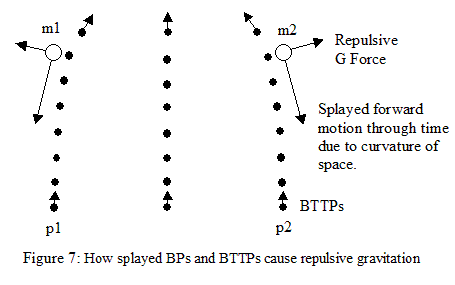
This theory’s basic formula for gravitational force, as mentioned earlier, is:
Fg = ˝mc˛(α – σ)/d . . . . . . . (32)
where α is the “deflection” angle and σ is the “splay” angle (both in radians). The effect of the larger mass M divided by its distance from m is built into α.
This equation is interesting in a number of respects. It has no need for a constant of gravitation, or any constant, for that matter (except for c, the speed of light, which this theory suggests may vary over long periods of time), thus it is very revealing of the nature of gravity. The lack of the need for a constant of gravitation is because the force of gravity on an object is a result of that object’s kinetic energy, as it moves forward through time at the speed of light (˝mc˛). We know that force = energy/distance, and there is no reason why gravitational force should be any different. The actual gravitational force, though, is only the result of the deflected kinetic energy divided by the distance from the attracting mass, which is why it is then multiplied by the net angle of deflection (α – σ). The mass of the larger object is not even needed, provided we know at what angle it deflects light and backward through time particles.
Gravitational Waves and Gravitons
Since the repulsion of BTTPs and basic particles of matter as they come together and collide produce the wave form of EMR, and gravitational force comes from a deflection caused by the same type of repulsion, it would be expected from this theory that gravitational forces causing objects to accelerate should produce similar waves, observed as traveling at the speed of light, but with a much lower energy and frequency corresponding to the general weakness of gravitational forces. Since, according to this theory, gravitational forces are produced by BTTPs and particles of matter just deflecting each other, not stopping each other as when EMR is produced, this theory predicts gravitational waves will never be found to have a particle nature in addition to their wave nature. So, this theory explains why gravitational waves have been observed, but just as waves and not also as gravitons.
Unification of Gravitation with Electromagnetic and Nuclear Forces
The gravitational energy of a smaller mass (m) in the gravitational field of a larger mass (M) is the gravitational force on m multiplied by the distance it can operate over, which is the distance, ‘d’ between the two masses. So this gravitational energy is:
Eg = ˝mc˛(α – σ)d/d
Which, cancelling out the ‘d’s becomes:
Eg = ˝mc˛(α – σ).
Since α – σ is the total angle of deflection of the backward through time particles (which have the same mass as m), we can see that the gravitational energy equals the deflected kinetic energy of these particles. If, instead of passing close by and only very slightly deflecting each other, producing gravitational energy, these particles collide, then, as we have previously seen, the whole kinetic energy of both particles will be released into the universal energy field to produce an energy of E = ˝mc˛ + ˝mc˛, or: E = mc˛.
In this way we can see that nuclear and electromagnetic energy and gravitational energy derive from the same kinetic energy of matter moving through time at the speed of light. Gravitational energy is just the tiny amount of the overall kinetic energy that is deflected as forward through time and backward through time particles pass by each other, whereas nuclear and electromagnetic energy come from all the kinetic energy in certain particles being released as they collide and make the transition from moving at the speed of light to being stationary within the universal energy field. As was foreshadowed earlier, this achieves the long-sought-after goal in physics of unifying gravitation with nuclear and electromagnetic forces. It also explains why gravity is a vastly weaker, but more pervasive, force than the electromagnetic force—it is created by tiny, continuous deflections of the kinetic energy of nearly all particles of matter, whereas electromagnetic forces arise from the total annihilation of the kinetic energy of a tiny percentage of particles that approach on an exact collision course and collide.
In terms of having just one universal equation for all the forces of nature, gravitational, nuclear and electromagnetic, the equation is this theory's basic equation for gravity:
Fu = ˝mc˛(α – σ)/d . . . . . . . (48)
The equation for electromagnetic and nuclear forces then becomes a special case of the gravitation equation where σ = 0 and α = 1 radian (the limit of gravitational deflection):
Fen = ˝mc˛(1 - 0)/d. . . . . . . or:
Fen = ˝mc˛/d . . . . . . . . (50)
When this force is applied over the unit distance, it produces an energy, in each or either domain, forward and backward through time, of:
E = ˝mc˛/1
This gives a total energy from both domains, when matter shifts to the EMR state, of:
E = ˝mc˛ + ˝mc˛ . . . . . . or:
E = mc˛
It comes down to this: all forces and all energy in the physical universe derive from speed-of-light kinetic energy. That is the unifying principle.
Other Issues in Physics the Theory Explains
This theory, through its model of the structure of the universe, goes on to explain a number of other previously unresolved issues in physics, including the speed and quantity of the fast solar wind, how black holes can be caused by large rotating masses rather than by stellar collapse, how such rotationally-caused supermassive black holes at the center of galaxies cause the gravitational anomaly that dark matter was proposed to explain, and why space within superclusters of galaxies is close to being flat, while the larger universe is, overall, approximately spherical. In every case the equations arising out of this theory produce values that are in close agreement with what astronomers have observed. In other words, this theory’s math does add up correctly and agrees with observed values, and this must give the theory some credibility. You can read about these other explanations, and examine for yourself the derivation of the theory's equations and the predictions that arise from them in the supplementary articles at the end of this article.
Perhaps the most important thing, though, that the Stationary Energy Theory gives physics the scope to explain, is the puzzling excess of order in a universe that one would expect to be reduced to a state close to random disorder (entropy). The rest of this article addresses this.
Stationary Energy Theory Explains the Existence of Cosmic Microwave Background Radiation and the CMB Rest Frame
The very basis of Stationary Energy Theory is that the electromagnetic radiation of the universe is at rest in a “stationary” universal energy field, and that our material universe is expanding through it at the speed of light. EMR originates from sources like light bulbs and stars, when “basic particles” moving forward in time at the speed of light collide with backward through time particles (BTTPs) moving backward through time at the speed of light. Their speed after the collision becomes zero, and they drop back into the EMR quantum state, and become a part of the stationary, Universal Energy Field (which appears to us to be moving at the speed of light, though it is in fact us that is moving—in the frame of reference centered on the primal event of the Universe, the Big Bang). Since the Big Bang, a substantial amount of matter has dropped back like this into the Universal Energy Field, and this has made much energy available to the universe. Let’s call this “New Energy.”
Under this theory, though, at the time of the Big Bang this energy field
already existed, and it was within it that the Big Bang took place and
expansion of the universe has taken place, and will continue to take place for
countless eons into the future. It seems reasonable to suppose that such a huge
energy field would not just have been empty at the time of the Big Bang, but
would already have been populated with a matrix of energy. Let’s call this “Old
Energy.” As the four dimensional spherical universe of matter expands past the
“particles” of energy in this matrix of Old Energy, one would expect the energy
to be detectable to us as EMR. It would not come from any discernable source,
though. It would just originate from countless “stationary points” in space and
spread out in all directions. This would make it appear highly diffuse and
scattered. And since it would be originating from “stationary points” no part
of it would show a
Doppler shiftDoppler Shift
A Doppler shift is an increase in the frequency of waves coming from a source that is moving toward you (as the waves bunch up), and a decrease in the frequency of waves coming from a source that is moving away from you (as the waves spread out). An example is the rise in pitch of the sound of a car that is approaching you and the sudden lowering of the pitch of that sound when the car passes you. Light from a star shows a red shift that can be seen in its spectrum when the star is moving away from us, and a blue shift if it is moving toward us. This is how astronomers measure the speed of stars and galaxies in the direction towards us or away from us.
different from any other, as none of it would
be coming from a moving source. Any Doppler shift we saw in this radiation would
have to be solely due to the Earth’s motion with respect to the
“stationary points” the Old Energy radiates from.
Stationary Energy Theory predicts that this “Old Energy” could exist and, if so, should be able to be detected as EMR. Indeed, I believe it has already been detected, because Cosmic Microwave Background Radiation (CMB) has exactly the qualities, just outlined, that this Old Energy should have.
The existence of the CMB “rest frame” is also evidence that, in space-time, all speeds are not just relative to each other, but that there actually are absolutely “stationary points” as this theory predicts. I propose that the CMB rest frame is one and the same as the grid of “stationary points” of this theory.
Under SET, this grid of stationary points with microwaves emanating from them are everywhere in the universe, guiding the evolution of all matter. This means that SET necessarily predicts that even in the deepest mine shaft, where no microwaves from the surface could penetrate, there should still be some old-energy microwaves present. They may well be too faint to be detected with current technology, but eventually should be able to be detected. The presence of such microwaves would also show that acceleration and gravitation are not fully equivalent, since they would originate inside an isolation "box" but could be used to calculate the speed of the "box" with respect to the CMB rest frame, which over time would also enable a within-the-box calculation of its acceleration.
Old Energy and Hindu Cosmology
Since the publication of The Tao of Physics by Fritjof Capra, we have become increasingly aware of the parallels between modern physics and some of the ancient wisdom from the East.
Hindu cosmology says there are three planes of existence, the “Causal,” a realm of pure ideas (like the world in which theoretical physicists work), the “Astral,” a realm of forms made only of energy, and the “Physical,” where the energy blueprint created in the Astral is transformed into physical reality. The physical universe is considered by Hindus to be a small clump of matter attached to the vastly larger Astral universe of “light” (or more specifically, according to Paramhansa Yogananda, "electromagnetic radiation") that dictates its form.
It has not escaped my attention that there is an uncanny similarity between this Hindu cosmology and the Stationary Energy Theory model of the universe I have presented here. The Universal Energy Field, within which the Big Bang happened, and into which the physical universe continues to expand, is like the Astral plane, a domain of pure energy, with the physical universe being substantially smaller than the Universal Energy Field, as it is continually expanding into it, and will, presumably, continue to do so for billions of years to come.
The Astral is filled with creative energy, and the Universal Energy Field is filled with “Old Energy” (as well as New Energy). The energy forms in the Astral are a blueprint for what emerges in the physical, so, to continue this parallel, could it be that the “Old Energy” (CMB) plays a similar role, and is a kind of continually evolving “blueprint” that is progressively “scanned” as we travel past it at the speed of light through time, and that it determines the forms that matter takes as it moves through time? It would need to be a continually evolving, reprogrammable blueprint in order to take account of the free-will decisions made by sentient beings, and not be a completely deterministic system.
In terms of the Stationary Energy Theory, one of the things this “scanned information” could code for would be which particular basic particles in matter would collide with oncoming BTTPs, and which wouldn’t. This would play a big part in determining, among other things, the energy levels of electrons around atoms, and in turn the whole chemistry of substances, and the biochemistry of life. It has been shown already that very faint but detectable beams of "biophotons" of visible light, UV light, and microwaves are emitted from living cells in organisms to coordinate biochemical reactions occurring in other cells of the same organism and, possibly, to communicate with other organisms. This theory sees biophotons as being an integral part of an overall mechanism that coordinates the universe, and also includes the high level cosmic blueprint of "old energy" that we have been talking about.
A widely acknowledged problem with the idea that CMB is just radiation left over from the intense energy of the Big Bang is how very uniform this energy is—it gives very little scope for the differentiation into galaxies and clusters of galaxies that has subsequently occurred. But if this radiation is also, and primarily, “coding” for how physical reality expresses itself (which could have been formed in the Big Bang), then in terms of a “picture,” one would expect it to be very uniform, with the variations occurring only on a very fine level. Look at the paragraphs on this page—they are just blocks of text. You can’t see a picture in them. When I look at a large paragraph without my glasses, its appearance is that of a mottled uniformity, rather like the pictures of CMB we see, such as this one, which also show a kind of mottled appearance:
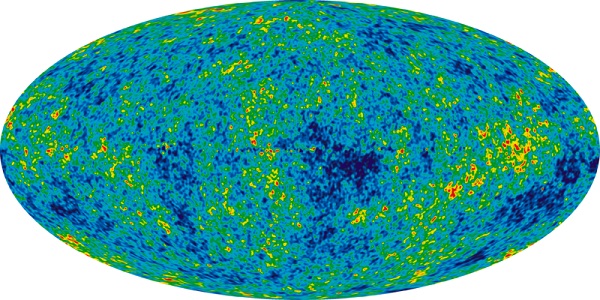
It is only if you look at a page of text with a resolution sufficient to see the fine detail, and the knowledge needed to decipher it, that you can see it is rich in information. Such could be the case with the “Old Energy” (CMB) that we see. So far we just see a mottled uniformity in it.
If the “Old Energy” does turn out to be “code,” though, (like the genetic code DNA stores) and we can one day learn to “read” and “write” this code, in what wonderful ways might we be able to bend reality to our bidding? For instance, we may, one day be able to draw energy out of the universe for human use, in a cheap, plentiful, safe and environmentally-friendly way.
Now we are like end users of a computer program, who can only learn the rules of the program, and figure out how to use it to our advantage. Then we will be like computer programmers, and be able to change the way the universe works whenever we wish to. Perhaps yogis, faith healers and other miracle workers and healers already know how to do this by using powerful concentration, intention and attunement to project microwave biophotons from their brains and hands onto the cosmic energy blueprint to overlay it and change it in subtle ways. Such reprogramming of reality could, of course, be fraught with many dangers, including upsetting the stability of the universe, so it would require great wisdom to use it to advantage. We might also expect to find, however, that much of the most fundamental code is “locked” so we can't undermine the stability of the universe.
An Explanation for the “Non-thermal Effects” of Microwaves
If the “code” for how the organized complexity of our universe unfolds is written in microwaves, as this theory suggests, then it would be possible that human-made microwaves, such as those used for microwave ovens, cell phones and wireless internet, could interfere with this coding and alter the structure and function of things in the material world. Living things would be the most likely to be affected over short periods, as their structure is so complex and they are continuously changing over short periods of time as they function. Living things would need to scan much more information from the coding microwaves than non-living things, so they would have to have better "antennas" to pick up the signal. And since the CMB "coding signals" are trillions of times less strong than cell phone signals, living cells would need to have exquisitely sensitive antennas, which, as it turns out, they do have. DNA molecules in cells are excellent conductors of electricity, due to their hydrogen-bonded backbone—so good that biological nanotechnology uses them as their conductor of choice. What makes DNA molecules even better antennas, though, is that they are folded into tiny balls in a fractal pattern where there are folds upon folds upon folds in the same pattern. This makes them "fractal antennas" that are known to be exquisitely sensitive because their length is maximized while their size is minimized. If DNA molecules are, indeed, extremely sensitive antennas, then it is easy to see how hugely more intense microwaves from cell phones and wireless internet, etc., could drown out the intended message, and even overlay it with a different, disruptive message. Research has shown that cell phone frequency, and levels, of pulsed microwaves cause DNA damage and random mutations during the replication process when cells divide. This means it is quite possible that the faint "coding microwaves" could code for correct transcription of the DNA, activate genes in a planned way, and even code for beneficial mutations that feed the evolution of organized complexity in living things.
The disruption of the function of living things by artificial microwaves might only, however, be expected to take place if the frequency of the artificial source corresponds to one of the frequencies nature uses to code for the function of living things, if the intensity of the artificial microwaves is sufficient to drown out the life signal (which it would certainly be if there is any usable signal), and if the artificial microwaves are present enough of the time that the life signals could not properly code for the needed life changes in the remaining time.
To help you understand the concept of this possibly informationally disruptive action of artificial microwaves, let me say it is very similar to how Captain Kirk and his officers destroyed the enemy fleet in the movie Startrek Beyond. They sent out a VHF radio signal at the frequency they knew would disrupt and wash out the very tight communications between the myriad ships of the enemy fleet. Their VHF signal didn’t directly do any damage to the enemy ships, it just disrupted their essential communications, likened to those between bees in a hive, and that in turn led to the destruction of the fleet as the ships lost control and crashed into each other.
In the light of the possibility that artificial microwaves could be informationally destructive to life in this way, it is interesting to note that “non-thermal” biological effects of microwaves, that can’t be explained by their energy content, have been well documented. For instance, people have got brain cancers in the parts of their brains near where they held their cell phones, and quite a few young women have got breast cancers exactly where they tucked their cells phones into their bras to store them. These cannot have been caused by the heat produced by the microwaves cell phones transmit, as the amount of heat produced is too small. A cell phone’s microwave transmissions only produce about one tenth of the heat on our head that comes from the sun shining on our head. On average, a cell phone radiates less than 100 mW during a conversation, only about one hundredth the amount of energy radiated by a flashlight bulb. That is why these effects are called “non-thermal” effects. Even quite large amounts of infra-red heat radiation cause no harm to living things, and microwaves are similarly non-ionizing and even less energetic, so it is highly unlikely that the small amounts of microwaves from cell phones could be directly damaging to living things because of the energy they carry. Microwaves, like all EMR, can however, in addition to energy, also carry information, and could do damage indirectly by interfering with and disrupting the reception of information living things need, whether this be an exchange of information between different parts of an organism, or the transmission to it of its blueprint for life as suggested by this theory. Hopefully, the underlying mechanism for non-thermal biological effects of microwaves and other EMR, presented here, will lead to a greater acceptance that there really could be non-thermal, informational, effects of such radiation that can cause health problems.
So, our use of artificial microwaves and other EMR is one area where we may be, albeit unwittingly, destructively deprogramming the physical world, perhaps to an extent well beyond what we are aware of. It follows from this that research into what frequencies and durations of microwaves and other radio waves cause non-thermal effects on living things, and what frequencies appear to have no non-thermal effects, could help make our use of microwaves and radio frequency signals for communication much safer. In the meanwhile it would make excellent sense to "play it safe" by minimizing our exposure to artificial microwaves and other EMR associated with health risks such as the ELF 60 Hz radiation caused by our electric power grid. In his excellent book on the dangers of cell phones, WiFi and other artificial EMR, Overpowered, Martin Blank calls this the "Precautionary Principle."
A Mechanism to Explain Organized Complexity in the Universe
John Barrow, in his book Theories of Everything, says, “The great unanswered question is whether there exists some undiscovered organizing principle which complements the known laws of Nature and dictates the overall evolution of the universe.” The scanning of the Old Energy blueprint this theory proposes could just turn out to be such an “organizing principle,” specifying the pattern for development of organized complexity in the universe in the face of the otherwise continually increasing disorder of entropy. Barrow goes on to say that the discovery of an organizing principle that specifies how the universe evolves, “…would be profoundly interesting because the universe appears to be far more orderly than we have any right to expect.” The existence of an ever evolving, continuously scanned blueprint, picked up by DNA fractal antennas in living things, would certainly explain this puzzling excess of order in the universe.
Stationary Energy Theory also answers a number of other questions that physics has previously been unable to answer. These include, fairly obviously, “What was before the Big Bang?” (The Universal Energy Field), “What is the universe expanding into?” (The Universal Energy Field), and “Why is the expansion of the universe accelerating?” (gravity turns negative at great distances). It also answers the questions, “Where did the materials that fed the Big Bang come from?” “Why are there voids between superclusters of galaxies?” “How do black holes form considering it has now been shown that they can't form as a result of stellar collapse?” and has the scope to explain why the laws of physics are exactly balanced for life to exist, and how quantum entanglement works. You will, however, have to read the additional series of articles, referenced at the end of this article, to find out about these.
Stationary Energy Theory suggests that intelligent coding specifies, moment by moment, how the organized complexity of the universe unfolds. Whether this is an impersonal intelligence (or consciousness), or whether there is a cosmic consciousness behind it that our consciousnesses are linked to, is something this theory is neutral about. This theory is, however, a
“biocentricBiocentric Universe
This is the idea that life and consciousness create the universe rather than the other way around.
Please click on the link for more information on this.”
theory, that suggests that consciousness of one sort or another creates the universe, rather than the other way around.
Articles on Further Details of the Stationary Energy Theory
02. A Simple Derivation of the Lorentz Transformation for Time Intervals (time-dilation)
03. The “Twins Paradox” and Time Dilation in Stationary Energy Theory
04. The Basic Structure of the Universe According to the Stationary Energy Theory
05. More on Basic Particles of Matter, including the Math
06. How Backward-Through-Time Particles Explain Gravity, Inertia & Angular Momentum
07. Details on How Gravitational Attraction Becomes a Repulsion at Great Distances
08. Gravitational Red Shift and the Speed of the Fast Solar Wind
09. Where the Raw Materials that Fed the Big Bang Came From
10. The Dual Nature of Matter and the Scope it Gives to Explain Quantum Entanglement
11. The Nature of Electromagnetic Radiation in a 4D Universe
12. Deriving Equations for Deflection, Splay and Gravitational Critical Distances
13. Structure of the Universe—Local Flattenings on a 4D sphere—dimples on a golf ball
14. Critical Distances of Small Particles, and How this Affects the Weather
15. Derivation of Stationary Energy Theory's General Equation for Gravity
16. Calculating the Rate of Acceleration of the Expansion of the Universe
17. How the Stationary Energy Theory Explains Black Holes
18. How Black Holes create the Gravitational Anomaly “Dark Matter” is inferred from
19. Refining the Equations for Gravitational Red Shift and Gravity
20. How Stationary Energy Theory Explains Much of the Mysteriousness of Space
21. Possible Parallel Universes in Stationary Energy Theory
Additional Articles:
22. How Energy Lost From the Gravitational Red Shift Can Power the Fast Solar Wind
24. An Easy Derivation of E = mc˛
Author: Mark J. Mason
The first publication of this complete theory was on July 6, 2011
Latest revision of the presentation: September 23, 2024
Feedback and offers of collaboration will be welcomed and seriously considered.
Contact information:
Website:
www.markmason.net/cotheory.htm
Copyright © 2011-2024, Mark J. Mason
Click here for the home page of my book, In Search of the Loving God, which includes three complete chapters from the book:
IN SEARCH OF THE LOVING GOD by Mark Mason
|
|